

In February 2021 India’s finance minister, Nirmala Sitaraman, in her annual Budget 2021, announced an allocation of 35,000 crore rupees towards coronavirus vaccines and a further 64,180 crore rupees towards healthcare over and above the annual healthcare outlay. That’s a whopping 14 billion US dollars towards coronavirus vaccination and healthcare. At an average price of 350 rupees per dose that will mean the budget provision would have enabled procurement of at least 1 billion vaccines and enable significant improvements to healthcare infrastructure.
The serum institute has a manufacturing capacity of 1.6 billion vaccines a year, which is now slated to further increase to 3 billion vaccines in the next 6 months. Bharat Biotech who can currently produce 150 million doses a year is expected to increase capacity to 750 million doses in a year within 6 months. Taking the Serum Institute of India’s (SII) available capacity alone is capable of delivering anywhere from 4 to 6.5 million vaccines a day.
If we were to take approximately 64% of the population to be over the age of 18 and eligible for vaccination that is a total number 832 million people who will form the target population. Off which 40 million have received two doses another 100 million have got a single shot. At the current rate of vaccination is 1.7 million people a day., it seems like we are closer to a 24 months away from having a fully vaccinated population.
The reason why there is a significant gap between the potential daily production capacity vs. vaccine administered every day is because of multiple factors. In April 2021, SII has confirmed to the Parliamentary Standing Committee on Science and Technology, Environment, Forests and Climate Change that neither producers are manufacturing to their available capacity. Incredible as that maybe, production capacity is merely the first hurdle. The logistical network and healthcare workforce needed to vaccinate a population of 1.3 billion even in a year makes it a Herculean task never done before.
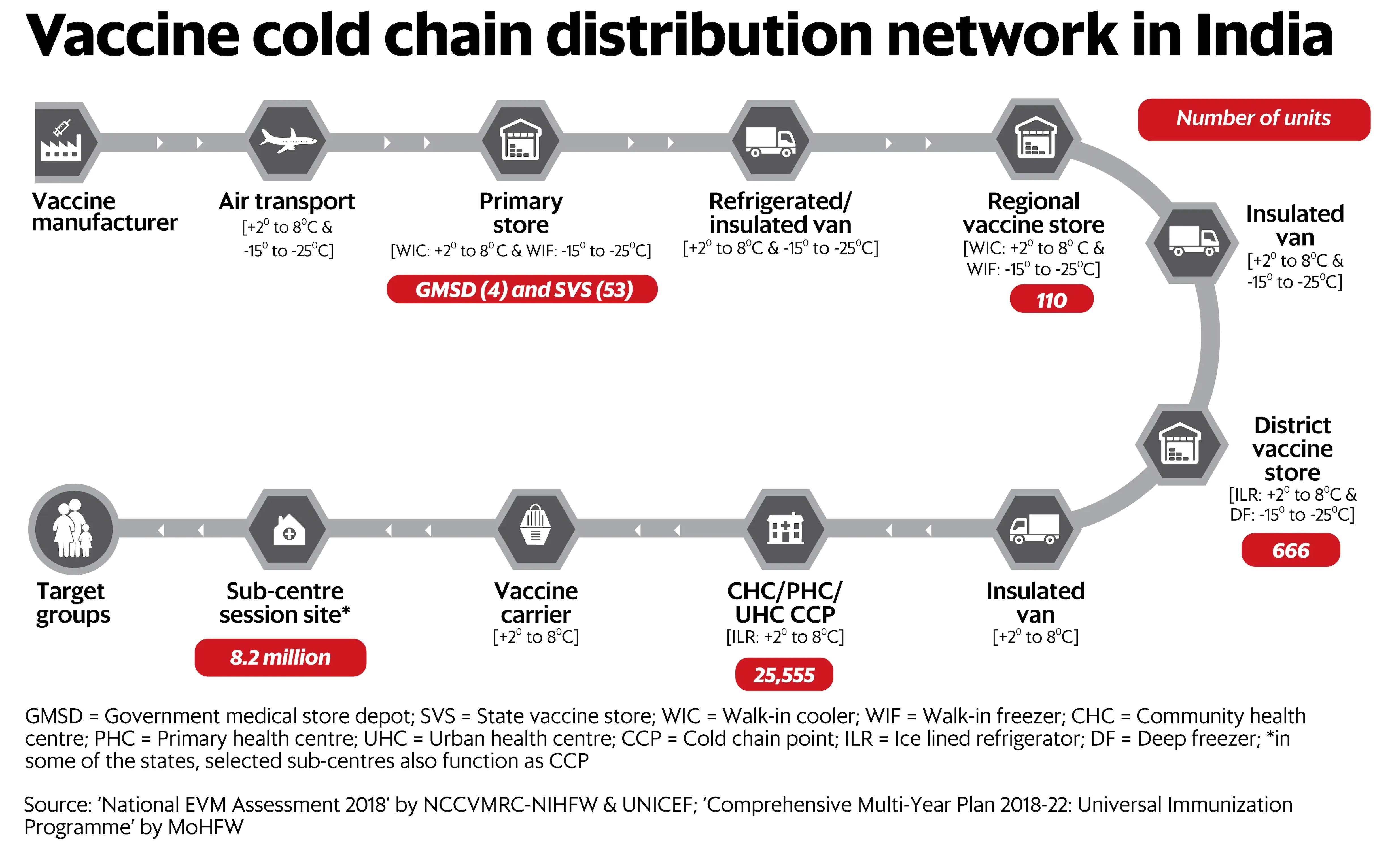
The current vaccines require storage temperature in the range of 2-8 degrees Celsius, therefore will require adequate cold storage facilities. The Strategy for COVID-19 vaccination in India lays out the distribution plans in detail. The government is airlifting the vaccines in cold boxes to four major depots. From the depots planes or insulated vans will carry the vaccines to state-wise stores. From the state-wise stores the vaccines are transported to temperature controlled facilities in the district level. Here the vaccines are stored in ice-lined refrigerators (ILRs) and they are transported to distribution centers in ice cooled boxes. According to a WHO report, 89% of vaccines were exposed to temperatures greater than the permissible 8 degrees Celsius in state level cold storage and 66% of boxes were exposed to higher temperatures during transit. Obviously with the complexity in the transfer and transportation requirements the losses in transit will be a major challenge, at least 25% of produced vaccines are known to degrade by the time they reach the destination. Even if this feat is achieved lossless the next challenge would be to enforce controls to prevent counterfeiting and to ensure the vaccine is not stolen.
Via the Universal Immunization Program (UIP) the government already has close to 85,622 cold chain facilities across 718 districts that service around 600 million doses annually and another 300 million doses via private collaboration. This will allow a transfer and storage of a maximum of 2.4 million doses a day. These capacity numbers assume that UIP can be put on hold, which obviously it cannot be stalled indefinitely. Therefore in order to meet the distribution challenge cold chain capacity will at least have to be doubled.
Once the vaccine reaches the distribution centers the next challenge is the healthcare workers. Under UIP the government has 55,000 cold chain staff and 2.5 million healthcare workers. . The current capacity is significantly stretched caring for those infected, so a workforce has to be trained up to administer the vaccines. This necessitates training millions of auxiliary nurses, midwives and other reasonably qualified healthcare workers to administer the vaccine. This will require some out of the box thinking, internet based learning, train the trainer programs and online and on the job certification to ensure the quality controls are in place.
If all of the above is not constraints enough India’s Health Ministry has taken an ill conceived step to allow states to bid externally for vaccines while the local manufacturer’s expand their production capacity. This obviously is unlikely to deliver huge benefits as this will merely trigger a bidding war amongst states. Given limited budgets, states will have significantly lesser bargaining power when compared to the national health ministry thereby not only limiting the numbers they may procure but also drive up the costs which thus far has not been a major concern. To compound matters the state-wise distribution seem inequitable, populous states like Uttar Pradesh has a 51% and Bihar has a 46% under allocation in proportion to their population vs. a state like Gujarat seems to have 75%, or Himachal at 121% over allocation in proportion to their population. This leaves some states feeling short supplied, exacerbating the need to look for other options.
In conclusion , India must not have a significant funding issue this year, with a budget allocation of 14 billion USD, however with committed export contracts and the limitations in production capacity India is likely to struggle with supply for the next 6 months. Beyond 6 months the constraint may not be supply as manufacturers will be able to expand capacity, but will be the cold storage, transportation and manpower. Unless significant investments are made in expanding cold storage facilities and training up an effective labor force, administering the vaccine will be bottlenecked and India will struggle to administer more than 3 million doses a day. What all of this tells us with some near perfect execution and some optimistic modelling India may be able to vaccinate their target age group of 18 and above with a single shot by mid 2022, they may be able vaccinate the total population with the second dose by Mar 2023.
Will India’s creaking healthcare infrastructure hold up for so long? How many people are likely to die in this time, as the death toll mounts? How much more can the economy take before it breaks? India has more questions than answers in this rather grim crisis.

 AVALUECREATOR
1 Comment